
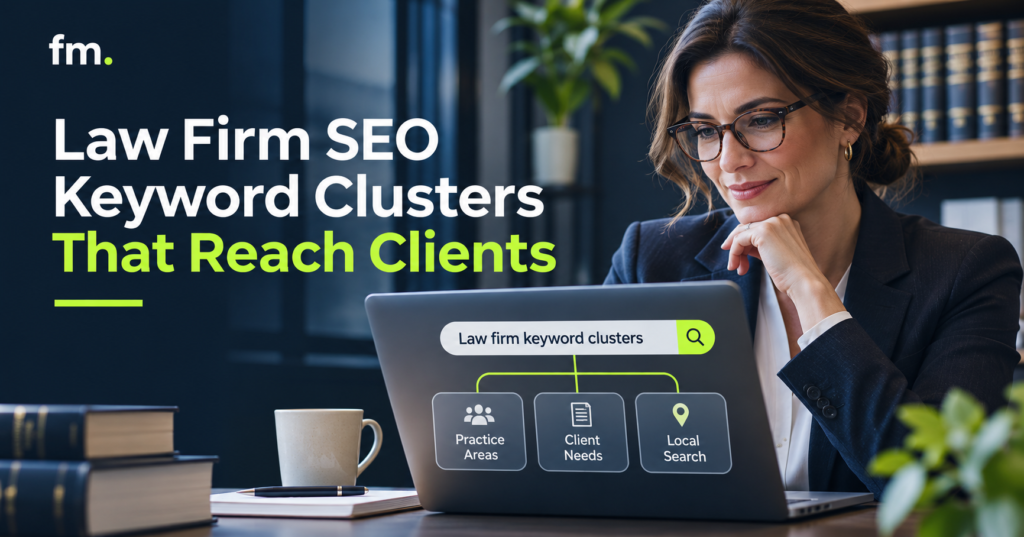
A successful law firm SEO strategy does more than target high-volume search terms. It connects practice-area pages, client questions, local searches, and relevant legal information into structured keyword clusters that help prospective clients find the right services.
This guide explains how to organize those clusters, avoid competing pages, and build a content system focused on attracting qualified legal inquiries rather than generating traffic alone.
Quick Answer
A law firm SEO strategy should organize keywords around the legal services prospective clients need, the questions they ask, and the locations a firm actually serves.
Instead of publishing unrelated articles targeting individual keywords, law firms can build topic clusters around their core practice areas.
Each cluster should have a primary service page supported by useful articles answering related questions.
For example, a personal injury firm could connect its car accident practice page with articles explaining insurance claims, medical documentation, and the stages of a personal injury case.
The goal is to help prospective clients move from researching their legal problem to understanding when professional representation may be appropriate.
Effective keyword clustering connects search intent, relevant information, and a clear next step.
In This Guide
- What keyword clusters mean for law firm SEO
- How prospective clients search for legal services
- Which keyword categories deserve priority
- How to build practice-area topic clusters
- How local SEO fits into the strategy
- How internal linking supports content discovery
- Common mistakes that create competing pages
- How to measure SEO performance and qualified inquiries
What Are Keyword Clusters in Law Firm SEO?
A keyword cluster is a group of related search terms organized around a shared topic or search need.
Rather than treating every keyword as a separate opportunity for a new page, clustering helps a law firm determine which searches belong together and which deserve distinct content.
Consider these searches:
- Car accident lawyer
- Attorney for a car accident injury
- Car accident legal representation
- Lawyer for an auto collision claim
These phrases may reflect similar commercial intent.
A law firm usually does not need four nearly identical service pages to address them.
One well-developed practice-area page can naturally cover closely related searches.
However, someone searching “what evidence should I collect after a car accident?” has a different information need.
That question may deserve a supporting educational article linked to the main service page.
This distinction forms the foundation of keyword clustering.
Primary Pages and Supporting Content
A practical SEO cluster usually contains two layers.
The primary page addresses the firm’s core legal service.
It explains the matters handled, the clients served, relevant procedures, and how someone can request legal assistance.
Supporting content addresses related questions that prospective clients may investigate before contacting an attorney.
These articles explain legal processes, documents, timelines, and common decisions.
The pages should connect through relevant internal links.
This structure helps visitors discover useful information while making the relationship between pages easier for search engines to understand.
Google’s SEO Starter Guide recommends clear site organization, helpful information, and language that reflects how people search.
Keyword clustering is one practical method for organizing that work.
Understanding How Prospective Legal Clients Search
Legal search behavior changes depending on a person’s circumstances.
Someone who has just experienced a legal problem may not know what type of attorney they need.
Another person may already understand the issue and be comparing law firms.
A useful SEO strategy recognizes these differences.
1. Problem-Aware Searches
These searches come from people trying to understand a situation.
Examples include:
- What happens after a workplace injury?
- How does the divorce process begin?
- What documents are needed for estate planning?
- What happens when an insurance claim is denied?
These queries usually call for educational content.
The article should explain the issue clearly, distinguish general information from case-specific advice, and help readers understand possible next steps.
Not every visitor will become a client.
However, relevant educational content can help the firm reach people who may eventually need its services.
2. Service-Aware Searches
These visitors already understand that legal assistance may be necessary.
Examples include:
- Personal injury attorney
- Family law lawyer
- Immigration attorney
- Estate planning law firm
These searches are often better suited to practice-area pages.
The page should explain what the firm does, whom it represents, and how prospective clients can begin an inquiry.
3. Local and High-Intent Searches
Some users include a specific location or indicate that they are ready to contact an attorney.
Examples include:
- Divorce attorney in [city]
- Estate planning lawyer near me
- Personal injury law firm in [county]
These searches create opportunities for localized service pages and accurate business information.
A firm should only target locations it genuinely serves and should avoid creating numerous nearly identical city pages.
4. Comparison and Decision Searches
People may also compare legal service options before contacting a firm.
Examples include:
- Do I need an attorney for probate?
- Lawyer versus mediator for divorce
- How do personal injury attorney fees work?
- What should I ask an estate planning lawyer?
These questions can support decision-oriented articles that explain relevant considerations without making exaggerated promises.
How to Build Keyword Clusters Around Practice Areas
The most reliable starting point is the firm’s actual service structure.
A law firm should not begin by collecting hundreds of unrelated keywords.
It should first identify the legal services it wants to support through organic search.
Step 1: Identify Core Practice Areas
Start with the firm’s main services.
For example, a multi-practice firm might handle personal injury, family law, and estate planning.
Each practice area may require its own keyword cluster.
The goal is to establish one clearly defined primary destination for each major service intent.
Step 2: Collect Related Client Questions
Review questions commonly asked during intake calls, consultations, and client communications.
These can reveal useful content opportunities.
For an estate-planning firm, recurring questions might concern wills, trusts, successor appointments, probate, and powers of attorney.
The firm should also review actual search queries, where data is available, through Google Search Console.
Search Console can show which queries generate impressions and clicks, and which pages appear for those searches.
Step 3: Group Keywords by Intent
Keywords should be grouped according to the problem a page needs to solve.
Two searches with similar wording may have different intentions.
Likewise, several different phrases may be answered effectively by the same page.
Before deciding whether to create a new article, examine the search results and existing content.
Ask whether the proposed page serves a genuinely different need.
Step 4: Map Keywords to Existing or Planned Pages
Assign each important search intent a primary URL.
If an appropriate page already exists, improve that page rather than automatically publishing a duplicate.
Create a separate supporting article only when it addresses a distinct question in meaningful depth.
This establishes a content map that can guide future production.
Example: A Practical Keyword Cluster Map for a Law Firm
The following is an illustrative planning framework, not a list of verified search volumes or ranking opportunities.
| Practice Area | Primary Keyword Theme | Supporting Content Opportunities |
| Personal Injury | Car accident lawyer | Insurance claims, evidence collection, claim timelines |
| Family Law | Divorce attorney | Filing process, mediation, custody considerations |
| Estate Planning | Estate planning lawyer | Wills vs. trusts, powers of attorney, successor trustees |
| Immigration | Immigration attorney | Family petitions, adjustment of status, interview preparation |
| Business Law | Business contract attorney | Contract review, common clauses, breach of contract |
Each primary theme connects to a relevant service page.
Supporting articles address narrower questions and link back to the appropriate service when that connection is useful to the reader.
A cluster should not be expanded simply to reach an arbitrary article count.
A small collection of thorough, accurate, well-connected pages is more useful than dozens of repetitive articles.
Why Search Intent Matters More Than Keyword Volume
Keyword volume estimates can help identify demand, but they do not tell a law firm whether a visitor is likely to need its services.
A broad legal question might receive substantial search interest while attracting people outside the firm’s jurisdiction or practice area.
A narrower search may reach fewer people but align more closely with the firm’s actual services.
For example, someone searching “what is a trust?” may be researching a general concept.
Someone searching for an estate planning attorney in a specific area may be closer to requesting professional assistance.
Both searches can matter, but they serve different purposes.
The law firm’s strategy should consider:
- Whether the search relates to a service the firm provides.
- Whether the visitor is likely to fall within its geographic or jurisdictional scope.
- Whether the page can answer the question accurately.
- Whether there is a natural next step for someone who needs representation.
The objective is not to maximize every possible impression.
It is to build useful visibility around the legal needs the firm is equipped to serve.
How Internal Linking Strengthens Keyword Clusters
Internal links connect related pages on the same website.
For law firms, they help visitors move between educational information and relevant services.
Consider an article explaining what happens after a car accident.
A reader may want additional information about the claims process, documentation, or obtaining legal assistance.
Relevant links can connect those needs without requiring the visitor to restart their search.
Google’s link best practices explain that internal links help search engines discover pages and understand their relationships.
Descriptive anchor text also helps readers understand the destination.
A Practical Linking Structure
A useful practice-area cluster might follow this pattern:
Main service page: Car accident representation
Supporting article A: What to do after a car accident
Supporting article B: Understanding accident insurance claims
Supporting article C: Documents relevant to an injury claim
Each article can link to the service page where appropriate.
The service page can also link to educational resources that answer common client questions.
Supporting articles may link to one another when they address connected issues.
These relationships should be based on usefulness, not an artificial requirement to insert a fixed number of links.
Local SEO: Connecting Keyword Clusters to Real Service Areas
Local search visibility is particularly relevant for law firms serving defined geographic markets.
A potential client may search for a legal service and expect results connected to their location.
Google explains that local ranking is primarily influenced by relevance, distance, and prominence in its Business Profile guidance.
A law firm should maintain accurate business information, including its name, address or appropriate service details, contact information, and operating hours.
Location-focused website content should also accurately represent where the firm operates and whom it can serve.
Avoid Repetitive City Pages
Creating a separate page for every nearby city is not automatically a sound local SEO strategy.
If those pages contain nearly identical descriptions and simply replace one city name with another, they may offer little additional value.
Google’s spam policies address doorway abuse, including groups of substantially similar pages created to target search variations.
A dedicated location page should have a meaningful purpose.
For example, it might describe an actual office, its services, accessibility, relevant local information, and contact options.
The firm should avoid implying that it maintains a physical office where none exists.
Connect Local Relevance to Client Needs
Local content is strongest when it reflects genuine client questions and the firm’s real practice.
This might include explaining jurisdiction-specific filing procedures or relevant local court processes when the firm has the knowledge and authority to provide accurate information.
Such content must be reviewed carefully because legal procedures and requirements can change.
How to Prevent Keyword Cannibalization
Keyword cannibalization occurs when multiple pages on the same website compete for similar search intent in ways that make the site’s content strategy less clear.
Not every situation in which two pages appear for related searches is a problem.
The real concern is unnecessary duplication.
For example, a firm might publish separate articles titled:
- Best Personal Injury Lawyer
- Top Personal Injury Attorney
- Personal Injury Legal Services
If each page provides essentially the same information to the same audience, creating three URLs may not improve the visitor experience.
A more useful approach may be to consolidate the material into one strong service page.
What to Do With Overlapping Pages
Begin by reviewing existing URLs and their search performance.
Determine whether the pages serve distinct purposes.
If they answer the same question, consider updating, consolidating, or redirecting content as appropriate.
Google provides canonicalization guidance for managing duplicate or highly similar URLs.
Canonical tags are not a substitute for useful content planning. The better starting point is deciding whether the site genuinely needs separate pages.
Creating Legal Content That Builds Trust
A law firm website should prioritize accuracy, clarity, and usefulness.
Legal content may influence decisions involving finances, family relationships, legal rights, or personal safety.
That makes content quality especially important.
Google’s people-first content guidance emphasizes useful, reliable information that serves readers rather than content created primarily to manipulate search rankings.
For law firms, that means articles should answer real questions and make appropriate distinctions between general legal information and advice about a particular matter.
Attorney Review and Professional Responsibility
Content production should include review by an appropriately qualified legal professional.
The reviewer should check substantive legal accuracy, jurisdictional references, claims about outcomes, and information that may require updates.
The American Bar Association’s Model Rule 7.1 addresses false or misleading communications about lawyers’ services.
Actual advertising rules vary by jurisdiction.
Law firms should avoid unsupported success claims, misleading comparisons, and promises about results.
A strong SEO strategy should build trust through accurate information rather than exaggerated language.
Turning Keyword Research Into a Repeatable Content System
Keyword research becomes difficult to manage when content planning, writing, review, and publishing happen through disconnected tasks.
A firm may have a spreadsheet containing keywords, a separate editorial calendar, documents awaiting attorney review, and published pages that are never revisited.
This creates an operational problem.
A more reliable content system connects those stages.
A Structured Content Workflow
A practical workflow can follow these stages:
1. Research: Collect relevant search questions, existing page data, and practice-area priorities.
2. Classification: Assign each proposed topic to a specific keyword cluster and search intent.
3. Content Mapping: Determine whether the topic requires a new article or an update to an existing URL.
4. Drafting: Prepare content using an approved brief, reliable sources, and the firm’s editorial standards.
5. Attorney Review: Verify legal accuracy, jurisdictional relevance, confidentiality, and advertising compliance.
6. Publication: Publish with appropriate titles, headings, internal links, and a clear next step.
7. Monitoring: Review performance and identify pages that need correction, expansion, or consolidation.
This makes content production easier to govern.
It also reduces the risk of repeatedly publishing articles that compete with existing pages.
Where Automation Helps
Automation can assist with routine tasks such as assigning content briefs, tracking review status, organizing approved assets, notifying reviewers, and preparing publication records.
However, automation should not independently decide substantive legal accuracy or approve claims about legal services.
Those decisions require appropriate human oversight.
Explore how Firm in Motion approaches these processes through its AI content automation solutions for law firms.
Firm in Motion Field Note: Governing Legal Content Production
Firm in Motion has designed a governed content operating system for a law firm involving multiple content input paths, research filtering, structured generation, approval controls, and multi-channel publication.
The system included automated discovery, relevance evaluation, persistent records, Gmail-based approval controls, regeneration paths, and workflow recovery.
The underlying implementation lesson is relevant to keyword-cluster management.
Producing content is only one part of the process.
A law firm also needs to control which topics enter its editorial pipeline, which existing pages they relate to, who approves the information, and when publication is authorized.
A keyword-cluster plan can serve as the organizing layer for this workflow.
Each approved topic can be associated with a practice area, search intent, target URL, supporting links, and responsible reviewer.
This is an application of systems thinking to legal SEO, not a claim that the cited content automation project achieved specific search ranking or lead-generation improvements.
For more implementation examples, visit Firm in Motion’s Systems Built.
How to Measure Whether Keyword Clusters Reach Prospective Clients
SEO performance should be measured at both the search visibility level and the inquiry level.
A page may attract visitors without generating relevant legal inquiries.
Another page may receive fewer visits but bring people who need a service the firm provides.
Both situations require different interpretations.
Search Performance Metrics
Google Search Console provides metrics such as impressions, clicks, click-through rate, and average position.
These can help identify which topics and pages are gaining visibility.
For example, a cluster may receive increasing impressions but relatively few clicks.
That could justify reviewing whether its page titles and content match search intent.
The firm should also examine whether the same search queries are associated with multiple overlapping pages.
Client Inquiry Metrics
Search visibility alone does not establish business value.
Where properly configured and consistent with privacy obligations, the firm can also monitor:
- Contact form submissions from organic search.
- Qualified consultation requests.
- Relevant phone inquiries.
- Practice areas associated with inquiries.
- Conversion rates for important service pages.
- Inquiries that become accepted matters.
These measures should be interpreted carefully.
Not every inquiry becomes a client, and not every visit can be attributed perfectly to a single search or article.
The goal is to understand which content helps prospective clients reach the firm, not to force every article into a direct sales calculation.
A Practical 90-Day Keyword Cluster Implementation Plan
A law firm can begin with a focused pilot rather than rebuilding its entire website.
| Phase | Priority | Main Deliverable |
| Days 1–30 | Audit existing pages, services, search queries, and overlapping content | Keyword-to-page map |
| Days 31–60 | Improve priority practice-area pages and develop supporting content | Initial topic clusters |
| Days 61–90 | Strengthen internal links, review publication quality, and establish reporting | Cluster performance baseline |
First 30 Days: Build the Map
Identify core practice areas, review existing pages, and group related queries according to search intent.
Select a manageable cluster with clear relevance to the firm’s services.
Avoid making publication volume the main objective.
Days 31–60: Improve the Core Pages
Ensure the primary service page answers essential prospective-client questions.
Develop supporting articles where genuine information gaps exist.
Connect the content through descriptive internal links and review the pages for legal accuracy.
Days 61–90: Validate and Improve
Confirm that important pages can be crawled and indexed.
Review early search performance, check inquiry tracking, and identify gaps in the content.
Use the findings to refine the next content cycle.
Ninety days is a planning period, not a promise of search ranking improvements. Organic search outcomes depend on many factors and may take longer to evaluate meaningfully.
Frequently Asked Questions
What is a law firm SEO strategy?
A law firm SEO strategy is a plan for improving a firm’s visibility in relevant organic search results.
It typically includes practice-area pages, keyword research, local relevance, technical website quality, useful legal content, internal linking, and performance measurement.
What are keyword clusters in legal SEO?
Keyword clusters are groups of related search terms organized around a common topic or search intent.
They help law firms create connected content while reducing unnecessary duplication.
How many keyword clusters should a law firm create?
There is no universal number.
A firm should begin with its actual practice areas and expand into related topics where prospective clients have distinct questions.
Quality, relevance, and maintainability matter more than the number of clusters.
Should every keyword have its own page?
No. Closely related keywords can often be addressed effectively by one comprehensive page.
Separate pages are useful when they serve meaningfully different search needs.
Does publishing more blogs automatically improve law firm SEO?
No. More content does not automatically create better rankings or qualified inquiries.
Articles should address real client questions, provide accurate information, and fit into a coherent website structure.
Can AI help with law firm keyword clustering?
Yes. AI can assist with organizing keyword research, grouping related topics, preparing briefs, and identifying possible content overlaps.
However, human review remains important for search intent, factual accuracy, legal compliance, and final editorial decisions.
Conclusion: Build Keyword Clusters Around Client Needs
A successful law firm SEO strategy is not a collection of isolated keywords or an endless publishing schedule.
It is a structured approach to connecting legal services with the questions prospective clients ask.
Start with the firm’s core practice areas. Identify meaningful search intent, build useful supporting content, and connect related pages through clear internal links.
Avoid publishing multiple pages that answer the same question without adding distinct value.
Equally important, establish a reliable process for researching, reviewing, publishing, and maintaining legal content.
When the content system is organized around actual client needs, the firm can evaluate which topics contribute to useful visibility and qualified inquiries.
The goal is not simply more website traffic. It is helping the right people find accurate information and understand how to contact the firm when legal assistance may be appropriate.