
Quick Answer
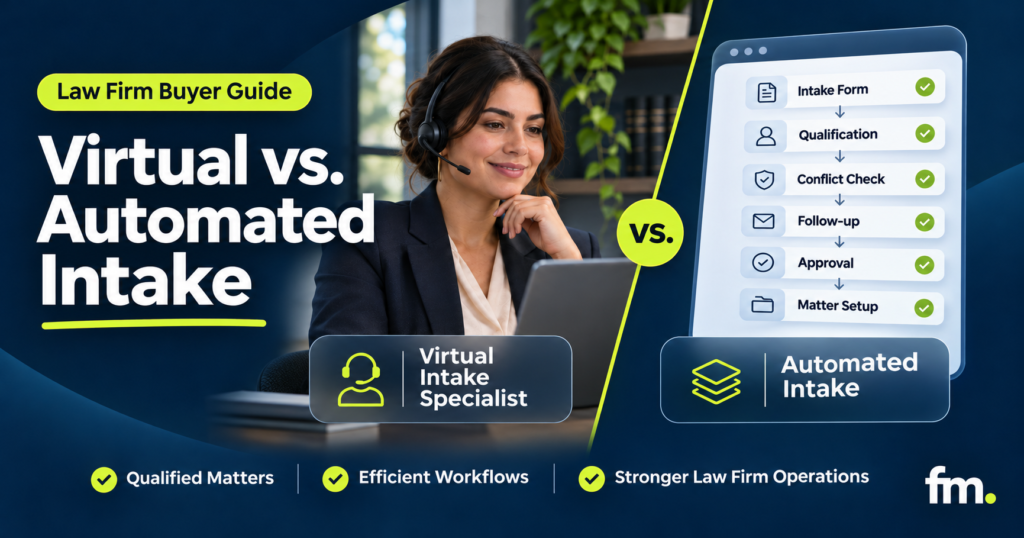
The best virtual intake specialists for law firms do more than answer incoming calls. They collect structured information, screen inquiries against the firm’s criteria, schedule consultations, document follow-ups, and route potential matters to the appropriate legal team.
Smith.ai, Ruby, Answering Legal, Alert Communications, and LEX Reception are worth considering, depending on the firm’s practice areas, call volume, coverage needs, and existing technology.
However, the best provider is not necessarily the service offering the longest operating hours or lowest monthly price.
A law firm needs an intake process that connects initial contact, preliminary qualification, conflict screening, attorney review, and matter management.
The objective is to automate routine coordination while keeping legal judgment and representation decisions under attorney control.
In This Guide
- What virtual intake specialists actually do
- Human versus AI-assisted intake services
- Comparing leading virtual legal intake providers
- Features law firms should prioritize
- Building a controlled intake-to-matter workflow
- Understanding costs and evaluating return on investment
- Confidentiality, supervision, and legal ethics
- A practical provider selection checklist
What Is a Virtual Intake Specialist?
A virtual intake specialist is a remote professional or technology-assisted service responsible for managing initial inquiries from prospective clients.
Unlike a general receptionist who primarily answers calls and forwards messages, an intake specialist follows a structured process to gather information and help determine what should happen next.
For a law firm, this may involve identifying the requested practice area, collecting contact details, documenting relevant dates, scheduling appointments, and identifying information that requires attorney attention.
The specialist may work directly for the firm, through an outsourced service, or as part of a technology-assisted intake operation.
Virtual receptionist versus virtual intake specialist
The two roles overlap, but their primary functions differ.
| Function | Virtual receptionist | Virtual intake specialist |
| Answer incoming calls | Primary responsibility | Usually included |
| Take messages | Yes | Yes |
| Schedule appointments | Often | Often |
| Collect matter-specific information | Varies | Core responsibility |
| Apply preliminary screening criteria | Limited or configurable | Usually expected |
| Identify potential conflict information | Depends on training | Can collect and flag |
| Update legal CRM records | Depends on integration | Important requirement |
| Make representation decisions | No | No |
A receptionist can become an effective intake resource when trained to follow a firm-specific screening process.
The distinction is therefore operational rather than merely a job title.
Why legal intake needs a defined workflow
Consider a prospective personal injury client contacting a firm after an accident.
A general message-taking service might record the caller’s name, telephone number, and request for a callback.
A trained intake specialist could also capture the incident date, location, general circumstances, relevant parties, and whether the caller has already retained another attorney.
Those additional details may help the legal team determine the urgency and appropriate next step.
However, the specialist should not independently determine liability, interpret legal deadlines for the caller, or promise that the firm will accept the case.
The value comes from collecting the right information and routing it correctly.
Human, AI, and Hybrid Virtual Intake Specialists
Virtual intake services generally fall into three operating models.
Each offers different advantages and implementation requirements.
Human virtual intake specialists
Human-led services use trained staff to answer calls, follow intake scripts, manage questions, and escalate complex situations.
They may be especially appropriate when callers are distressed, have complicated circumstances, or require sensitive communication.
A human specialist can recognize when a conversation is becoming difficult to manage and request attorney intervention.
However, service quality depends on training, supervision, availability, and consistency.
AI-powered intake assistants
AI-assisted systems can answer certain inquiries, ask structured questions, summarize responses, and trigger follow-up actions.
These capabilities may help firms handle high inquiry volumes or offer additional after-hours coverage.
The risks arise when automated systems misunderstand responses, misclassify legal issues, collect unnecessary confidential information, or communicate beyond their authorized scope.
An AI intake system should have clear limitations and an accessible human escalation path.
It should also be evaluated for data retention, recording practices, transcription accuracy, and vendor access to prospective-client information.
Hybrid intake services
Hybrid models combine automated handling with human assistance.
A system might collect initial contact information or route straightforward requests automatically, while a trained specialist handles complex questions or escalations.
This can be useful when the firm wants structured data capture without requiring every caller to complete the same rigid process.
However, a hybrid label alone does not guarantee a better system. The firm should verify exactly when a human becomes involved and whether the service can transfer the conversation with its existing context.
Choosing the right model
| Model | Potential advantage | Primary limitation |
| Human-led | Flexibility, empathy, complex conversations | Staffing capacity and variable handling costs |
| AI-assisted | Consistent structured tasks and scalable availability | Misinterpretation, escalation, privacy, and quality-control risks |
| Hybrid | Combines automated handling with human intervention | More complicated routing and handoff design |
The appropriate model depends on the firm’s client population, inquiry complexity, risk tolerance, and operational requirements.
Best Virtual Intake Specialists for Law Firms: Provider Comparison
The providers below offer different combinations of call handling, legal intake, scheduling, and workflow support.
The comparison is based on publicly documented services, not independent hands-on testing. It does not represent a universal ranking of customer satisfaction or legal compliance.
| Provider | Primary strength | Best-fit situation |
| Smith.ai | Custom screening, CRM integrations, human and AI-assisted intake | Firms seeking connected, technology-assisted intake |
| Ruby | Human-led reception, chat, scheduling, caller experience | Smaller firms prioritizing personal communication |
| Answering Legal | Legal-focused reception, custom intake, around-the-clock coverage | Firms needing outsourced legal call handling |
| Alert Communications | Detailed legal screening, bilingual intake, campaign-volume support | Personal injury, litigation, and high-volume intake teams |
| LEX Reception | Legal receptionist services and intake coordination | Firms seeking a legal-focused reception operation |
1. Smith.ai
BEST FIT: CONNECTED INTAKE AND CRM WORKFLOWS
Smith.ai provides virtual receptionist and AI-assisted intake services that can collect lead information, ask firm-defined qualification questions, schedule consultations, and transfer information into connected software.
Its June 2026 intake documentation describes custom screening questions and CRM updates. A subsequent October 2026 product update documents direct Lawmatics scheduling and CRM integration for both its AI Receptionist and Virtual Receptionist services.
Smith.ai+1
For a firm already investing in intake automation, the advantage is the ability to connect the initial conversation to downstream follow-up activity.
However, buyers should confirm which integration features are included in their selected service and how complex conversations are escalated.
Evaluation priority: Test a real practice-area screening script, incomplete information, duplicate CRM contacts, and the live-agent escalation process.
2. Ruby
BEST FIT: HUMAN-LED CLIENT COMMUNICATION
Ruby provides live virtual receptionists and website chat services for law firms.
Its legal service documentation lists appointment scheduling, customized call handling, client intake, live chat, and 24/7 coverage.
24/7 Receptionists & Chat Support
Ruby may be suitable for a solo or small firm that wants a professional human response to inquiries without maintaining full-time internal reception coverage.
The critical question is how deeply the reception process can follow the firm’s specific legal screening requirements.
A service that provides a positive caller experience still needs to deliver useful, structured information to the attorney.
Evaluation priority: Confirm intake depth, supported CRM handoffs, after-hours service requirements, and how sensitive inquiries are handled.
3. Answering Legal
BEST FIT: LEGAL-SPECIALIZED PHONE COVERAGE
Answering Legal focuses specifically on law firms.
The company documents U.S.-based receptionists, 24/7 call handling, customized legal intake, English and Spanish coverage, and integrations with legal CRM and practice management systems.
Answering Legal+1
This model can be relevant for firms whose main intake challenge is consistently answering calls while attorneys are unavailable.
Its legal-specific training may also make it easier to configure practice-area intake questions.
However, firms should determine whether the service’s intake process matches their exact screening, escalation, and documentation requirements.
Evaluation priority: Test urgent-call routing, missed-call recovery, message accuracy, and whether structured intake data reaches the correct CRM fields.
4. Alert Communications
BEST FIT: HIGH-VOLUME AND PRACTICE-SPECIFIC LEGAL INTAKE
Alert Communications provides legal intake services with 24/7 staffing, bilingual support, and screening processes configured around the firm’s requirements.
Its documentation describes practice-area qualification, CRM delivery, conflict-related information collection, consultation scheduling, and retainer coordination. It also describes services intended for mass tort and high-volume litigation campaigns.
alertcommunications.com+1
This may make Alert relevant to firms receiving substantial inquiry volumes from advertising campaigns.
The important distinction is between collecting information that supports legal evaluation and actually making a legal determination.
The firm should preserve attorney control over substantive assessment and representation approval.
Evaluation priority: Examine intake consistency during demand spikes, quality assurance procedures, data completeness, and the approval steps preceding retainer workflows.
5. LEX Reception
BEST FIT: LEGAL-FOCUSED RECEPTION SUPPORT
LEX Reception is another provider worth including when comparing outsourced legal receptionist services.
It can be considered by firms seeking an external intake team that follows defined call-handling instructions and forwards prospective-client information.
Before selecting it, confirm its current service coverage, intake capabilities, integrations, pricing, and escalation procedures directly with the provider.
Those details should not be assumed to match the other vendors in this comparison.
Evaluation priority: Request a demonstration showing how a real prospective-client call becomes a complete, assigned intake record.
Which virtual intake specialist is best?
There is no single provider that is best for every law firm.
Smith.ai is a useful candidate when the objective is connected intake with CRM automation.
Ruby and Answering Legal deserve consideration when human-led caller handling is the priority.
Alert Communications is relevant for detailed screening and higher-volume legal intake operations.
LEX Reception provides another legal-focused option to evaluate.
The final decision should come from testing each provider against the firm’s actual intake process, not simply comparing advertised service features.
Essential Features to Evaluate Before Hiring
A virtual intake provider should be judged by what happens after the first conversation.
Structured screening questions
The firm should be able to specify which questions must be asked for different practice areas.
For example, family law, immigration, estate planning, and personal injury inquiries may require different information.
The intake process should adapt accordingly, with clear escalation when the caller’s situation does not fit a standard route.
CRM and matter-management integration
The intake specialist should be able to deliver information in a usable format.
Where supported, structured records should move into platforms such as Clio Grow, Lawmatics, Filevine, or other systems used by the firm.
A simple email summary may be sufficient for some small practices. For others, manual re-entry creates unnecessary administrative work.
The firm should verify field mapping, duplicate detection, and whether data synchronization actually succeeds.
Appointment scheduling
A good intake process should identify when a consultation is appropriate, check available scheduling options, and communicate the next step clearly.
Scheduling should not bypass required preliminary screening or create the impression that representation has already been accepted.
Escalation and exception handling
Every provider needs instructions for situations it cannot resolve.
Examples include an urgent deadline, a possible conflict, a distressed caller, a language barrier, or an inquiry outside the firm’s usual services.
The system should identify who receives the escalation, how quickly it is routed, and what happens if the responsible person is unavailable.
Reporting and accountability
Useful reporting should include not only calls answered but also intake completion, appointments booked, qualified opportunities, and failures requiring correction.
This helps the firm measure whether the service improves its operating process instead of merely increasing the number of messages collected.
Designing a Virtual Intake-to-Matter Workflow
A virtual intake specialist should be one component within a governed legal workflow.
The process should begin with capturing the inquiry and end with a verified next step.
Example: Attorney-Controlled Virtual Intake Workflow
1. Inquiry Received
Call, form, chat, or referral
2. Structured Intake
Collect permitted contact and matter information
3. Preliminary Screening
Check firm-defined criteria and flag exceptions
4. Conflict Review and Attorney Gate
Human judgment and representation decision
Approved
More review
Declined
5. Engagement Requirements
Agreement, signature, and applicable payment conditions
6. Matter Creation
Store validated data in the practice management system
Stage 1: Capture the initial inquiry
The intake process should create a record with an owner, inquiry source, contact details, and receipt time.
The system should also check for existing contacts or related inquiries.
Stage 2: Apply a practice-specific interview
The specialist should follow questions approved by the firm.
The objective is to gather enough information to support the next decision, not to conduct an unrestricted legal consultation.
Stage 3: Flag potential issues
The process should identify missing facts, possible conflicts, urgency indicators, or inquiries outside the firm’s services.
These issues should trigger an appropriate review or escalation rather than an automatic legal conclusion.
Stage 4: Obtain attorney authorization
An authorized attorney reviews the information and decides whether the opportunity may proceed.
The specialist should not make legal promises or independently authorize representation.
Stage 5: Complete engagement requirements
If the firm approves the opportunity, the workflow can coordinate permitted administrative steps, including sending the appropriate engagement paperwork.
The attorney must remain available for questions about the scope and terms of representation, consistent with applicable rules.
Stage 6: Create the matter
Only after the firm’s required conditions are met should the system move the approved opportunity into active matter management.
The information gathered at intake should carry forward where appropriate, reducing repeated entry.
Virtual Intake Specialist Costs: What Law Firms Should Compare
The price of an outsourced intake service depends on the operating model, coverage, usage, and work included.
Services may charge for answered calls, minutes used, monthly capacity, dedicated staffing, or additional intake activities.
The least expensive entry-level service may not be the least expensive way to manage a complete legal intake process.
Common pricing models
| Pricing model | How it works | What to investigate |
| Per-minute | Usage based on call-handling time | Long calls, rounding, and overages |
| Per-call | Fee based on handled calls | Spam, transfers, repeat calls, and intake depth |
| Monthly package | Defined coverage or included usage | Allowances, exclusions, and extra charges |
| Dedicated staffing | Reserved specialist hours or capacity | Supervision, backup, and coverage |
| AI usage | Software or interaction-based fee | Escalations, setup, integrations, and monitoring |
Some providers also charge separately for onboarding, integrations, outbound calls, additional languages, or other services.
As one current public example, Alert Communications lists monthly packages and a pay-as-you-go option on its website. Its published plans distinguish message-taking from intake and retainer coordination, and warn that setup fees, overages, and add-ons may apply.
Alert
That pricing illustrates why the scope of service matters more than comparing one headline number.
Calculate cost per qualified opportunity
A firm should measure how many useful, attorney-reviewable opportunities the service produces.
A simple operational calculation is:
CostperQualifiedOpportunity=TotalIntakeServiceCostQualifiedOpportunities
This is not the same as cost per hired client.
To calculate that metric, divide the total relevant intake costs by the number of accepted engagements attributable to the service.
The firm should also consider internal supervision, integration, and quality-control costs.
Hypothetical cost comparison
Illustrative example only. These are not provider quotes or observed results.
SERVICE A
$800
Monthly cost
20
Qualified opportunities
$40 each
SERVICE B
$1,200
Monthly cost
40
Qualified opportunities
$30 each
In this hypothetical comparison, Service B has a higher monthly price but a lower cost per qualified opportunity.
However, this does not prove that Service B produces better cases or higher revenue. Those conclusions require further data about accepted matters and financial outcomes.
Legal Ethics and Confidentiality Requirements
Virtual intake introduces responsibilities that law firms cannot delegate entirely to a vendor.
The legal team must remain responsible for professional judgment, supervision, and appropriate handling of prospective-client information.
Supervising nonlawyer intake personnel
ABA Model Rule 5.3 addresses lawyers’ responsibilities regarding nonlawyer assistance.
Its requirements extend to ensuring that outsourced services operate in a manner compatible with lawyers’ professional obligations.
ABA Formal Opinion 506 explains that properly supervised nonlawyers can assist with collecting initial information, preliminary conflict checks, and certain administrative intake activities. It also emphasizes preserving access to the lawyer for questions about fees and the scope of representation.
americanbar.org+2
A firm should therefore provide written instructions and supervision rather than relying entirely on a vendor’s general training.
Protecting prospective-client information
ABA Model Rule 1.18 addresses duties to prospective clients, including restrictions on the use or disclosure of information learned during certain consultations, even when representation does not follow.
americanbar.org
An outsourced intake service may therefore encounter sensitive information before a formal engagement exists.
The firm should consider data minimization, access permissions, vendor confidentiality commitments, retention, call recording, and secure transmission into its CRM.
Model Rule 1.6 and its commentary also inform the firm’s confidentiality and vendor oversight responsibilities.
americanbar.org+1
Preventing unauthorized legal advice
An intake specialist may explain an approved administrative process or collect information using a firm-defined script.
They should not independently evaluate legal rights, promise a case outcome, or provide individualized legal advice outside what the applicable jurisdiction permits.
The service must know when to stop answering and route the question to an attorney.
Connecting Virtual Intake with Law Firm Automation
A law firm may already have competent receptionists and a capable CRM but still experience administrative friction.
The problem often appears between the tools.
For example, a virtual specialist may collect detailed information, but a staff member must then manually copy the details into the intake platform.
After attorney approval, someone may again enter the same information into document software, a payment system, and matter management.
Those repeated handoffs can be redesigned.
Firm in Motion field note: Attorney-controlled intake workflows
Firm in Motion has implemented legal service automation connecting Gavel, Clio Manage, Make.com, Stripe, Gmail, and Google Calendar.
The implemented workflows included structured intake, conflict review, attorney approval or decline decisions, retainer generation, payment handling, and matter creation.
The important implementation principle was not simply connecting applications.
It was establishing the conditions under which a workflow should continue, pause, return for correction, or stop.
That principle is directly relevant when introducing outsourced or AI-assisted intake.
A virtual intake specialist can gather the information, while a connected operating system manages the authorized next steps.
The goal is to reduce repeated coordination without transferring legal judgment away from attorneys.
Explore Firm in Motion’s Legal Workflow Automation approach to connected intake and matter operations.
Practical Checklist: Choosing the Best Virtual Intake Specialist
Before selecting a provider, test whether the service fits the firm’s real intake conditions.
Virtual Intake Provider Readiness
0 / 10
The provider can follow our practice-specific intake questions.
We have confirmed human, AI, and escalation coverage.
Prospective clients are not promised representation.
Potential conflicts and urgent matters follow defined escalation rules.
Intake information reaches the correct CRM record.
The provider can handle missing or incomplete information.
Confidentiality, recording, and access procedures are documented.
Service pricing includes clearly defined usage and overage terms.
We can review call quality and intake accuracy.
The firm retains control over legal screening and representation decisions.
Copy checklist
How to test a provider before committing
Use a small collection of simulated inquiries representing realistic intake situations.
Include a straightforward prospective matter, an incomplete inquiry, an urgent issue, a possible conflict, and a caller requesting legal advice.
Evaluate whether the specialist follows the correct questions, records the information accurately, and escalates appropriately.
Also inspect the resulting CRM records.
A service that handles conversations well but creates incomplete or duplicate intake records may simply move administrative work into another part of the firm.
Common Mistakes When Outsourcing Legal Intake
Selecting a service based only on cost
A lower monthly fee may be attractive, but the total expense depends on the quality and completeness of the work delivered.
Compare the cost of the finished intake process, including follow-up and internal correction time.
Using the same screening script for every practice area
Different legal services require different preliminary questions.
One generic questionnaire may collect unnecessary details for some inquiries while missing essential information for others.
Build separate screening paths where the differences matter.
Treating a screening result as legal approval
A provider may classify an inquiry as suitable based on criteria supplied by the firm.
That classification should not automatically authorize representation.
The workflow must preserve the attorney’s required decision points.
Failing to monitor outcomes
Outsourcing does not eliminate the need for management.
The firm should regularly review intake quality, incomplete records, escalation handling, and eventual engagement outcomes.
The objective is not simply to answer more calls. It is to move the right opportunities through the process reliably.
Frequently Asked Questions
What is the best virtual intake specialist for a small law firm?
Smith.ai, Ruby, and Answering Legal are useful candidates for small firms. The best choice depends on whether the firm prioritizes CRM-connected intake, human caller experience, or legal-specific call coverage. A workflow demonstration is more useful than relying on a general ranking.
Can virtual intake specialists qualify legal leads?
Yes. Trained specialists can collect information and apply firm-defined preliminary screening criteria. However, qualification for administrative routing should remain separate from attorney decisions about conflicts, legal merit, and representation.
Can an AI receptionist replace a legal intake specialist?
AI can perform some structured intake tasks, but it may not handle every caller or complex situation reliably. Firms should evaluate whether human assistance is available and establish clear rules for escalating legal questions, sensitive issues, and unusual circumstances.
How much does a virtual legal intake service cost?
Costs vary by provider, coverage, usage, and services included. Common billing arrangements include per-minute, per-call, monthly packages, and dedicated staffing. Buyers should obtain a current quote that includes onboarding, integrations, overages, and additional services.
Can a virtual intake specialist work with Clio or Lawmatics?
Some providers offer integrations with legal CRM platforms, including Clio and Lawmatics. The precise capabilities depend on the provider and service plan. Firms should verify whether intake answers populate structured fields or are merely attached as notes.
Are outsourced legal intake services ethical?
They can be used consistently with professional obligations when properly supervised and configured. Lawyers must consider confidentiality, nonlawyer supervision, limitations on legal advice, and applicable jurisdiction-specific rules. Outsourcing does not transfer professional responsibility away from the firm.
Conclusion: Choose the Intake System, Not Just the Answering Service
The best virtual intake specialists help law firms do more than respond to incoming calls.
They support a process where prospective clients receive appropriate attention, relevant information is collected consistently, and the legal team receives a usable record for evaluation.
However, even a capable provider cannot compensate for an undefined intake workflow.
A firm still needs clear screening criteria, escalation procedures, confidentiality safeguards, attorney approval gates, and reliable connections to its existing systems.
Before choosing a service, identify where the current process breaks. Determine whether the primary challenge is unanswered calls, inconsistent screening, delayed follow-up, duplicate records, or manual transfers between applications.
Then select a provider that fits those needs and test the full process.
A reliable intake operation should allow routine coordination to move through the system while preserving human judgment at consequential legal decisions.
Next step: Firm in Motion helps law firms design connected, attorney-controlled intake and operations systems. Schedule Your Law Firm Systems Audit to identify which intake handoffs can be automated and where professional oversight should remain.
Sources and Further Reading
- Smith.ai: Virtual Receptionists for Lead Qualification and Intake
- Smith.ai: Lawmatics Integration Update, October 2026
- Ruby: Virtual Receptionists and Live Chat for Law Firms
- Answering Legal: Legal Answering and Intake Services
- Alert Communications: Legal Intake Services
- ABA Model Rule 5.3: Nonlawyer Assistance
- ABA Formal Opinion 506: Legal Assistants and Client Intake
- ABA Model Rule 1.18: Duties to Prospective Clients