
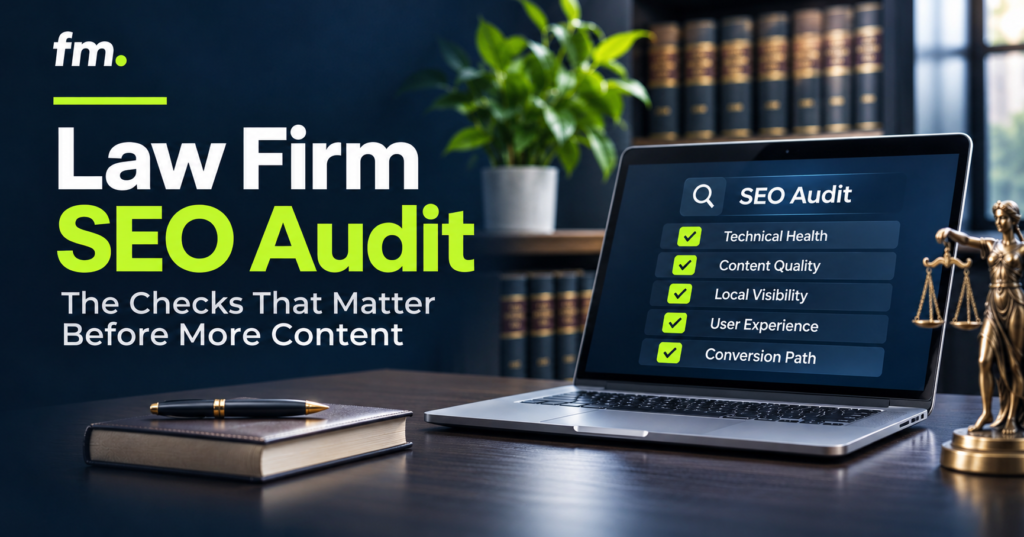
Publishing more articles does not automatically improve a law firm’s search visibility. If important pages are not indexed, service content overlaps, local business information is inconsistent, or visitors cannot easily contact the firm, additional publishing may do little to address the underlying problem.
A law firm SEO audit identifies these weaknesses before the firm invests in another round of content production.
The purpose is not simply to generate a technical report. It is to understand whether the website can attract relevant searches, communicate legal expertise, and turn qualified visitors into prospective clients.
Quick Answer
A law firm SEO audit is a structured review of a legal website’s technical health, search visibility, content quality, local presence, internal links, and conversion paths.
Before publishing more content, a law firm should verify that its important pages can be crawled and indexed, each core service has a clear search purpose, existing articles provide useful information, and local business signals accurately represent the practice.
The audit should also examine mobile usability, page performance, attorney credibility, and the process used to review and publish new material.
The central principle is simple: fix the infrastructure supporting existing content before increasing publishing volume.
In This Guide
- Why publishing more content may not solve SEO problems
- The technical checks that deserve attention first
- How to audit practice-area pages and search intent
- Local SEO and Google Business Profile checks
- Content quality, legal accuracy, and attorney credibility
- Internal linking, user experience, and conversion tracking
- A practical audit prioritization framework
- How to build a controlled SEO publishing process
Why Law Firms Should Audit Before Publishing More Content
Content production is often the most visible part of a law firm’s SEO strategy.
New blog posts, practice-area pages, FAQs, and location pages create a sense of progress.
However, a larger website is not necessarily a stronger website.
Imagine a personal injury firm with dozens of articles about car accidents. Some pages answer nearly identical questions. Others lack clear internal links to the firm’s main car accident service page.
Meanwhile, the primary service page has weak content, an unclear contact form, and indexing problems.
Publishing ten more car accident articles would not directly resolve those issues.
The firm first needs to understand how its existing pages perform together.
More Content Can Increase Existing Problems
When a website lacks a clear content structure, adding pages can create additional duplication and maintenance work.
Several articles may compete for similar searches. Important service pages may receive insufficient internal linking. Old legal explanations may remain published without review.
Google’s Search Essentials emphasizes helpful, reliable content, crawlable links, and clear information that helps search engines understand pages.
Its guidance does not suggest that publishing frequency alone produces better rankings.
A law firm SEO audit should therefore begin by identifying what is already working, what is broken, and what is missing.
1. Check Crawling, Indexing, and Canonical URLs
Technical accessibility is the first priority.
A well-written page cannot reliably attract organic search traffic if search engines cannot access or index the intended version.
The audit should establish whether important pages are discoverable, accessible, and eligible for indexing.
Review Google Search Console
Google Search Console provides information about how Google discovers, indexes, and displays a website.
Start with the firm’s most important URLs:
- Homepage
- Primary practice-area pages
- Attorney profiles
- Office location pages
- High-value informational articles
Review the Page Indexing report and inspect representative URLs.
Pay particular attention to unexpected exclusions, crawling errors, and pages that Google has discovered but not indexed.
Not every excluded URL represents a problem. Duplicate pages, redirects, and intentionally excluded administrative URLs may have valid reasons for remaining outside the index.
The audit should distinguish legitimate exclusions from problems affecting valuable pages.
Verify Canonicalization and Sitemap Quality
Canonicalization helps search engines identify the preferred version of similar or duplicate content.
For example, multiple URLs may accidentally display the same practice-area page.
A canonical tag can indicate the preferred URL, although Google ultimately selects its own canonical based on multiple signals.
Review whether important URLs use appropriate canonical signals and whether the XML sitemap lists the intended indexable pages.
Also check that the site does not accidentally block important pages through robots directives or incorrect noindex settings.
A sitemap supports discovery. It does not guarantee indexing.
Practical takeaway: Confirm that important existing pages are technically accessible before funding new content for the same website.
2. Audit Practice-Area Pages and Search Intent
A law firm’s practice-area pages usually serve a different purpose from educational blog articles.
Someone searching for a personal injury lawyer may want representation.
Someone searching for how personal injury settlements work may want information.
These searches can be related, but their immediate intent differs.
A strong website gives each important search need an appropriate destination.
Map One Main Page to Each Core Service
For every major practice area, identify the primary page designed to explain that service and help prospective clients take the next step.
A family law firm, for example, might maintain distinct primary pages for divorce representation, child custody, and other materially different services.
Supporting articles can answer specific client questions and link back to the appropriate service page.
Problems arise when several pages target the same underlying need without providing meaningful differences.
Identify Content Overlap
Keyword cannibalization is commonly used to describe situations where a site’s pages compete for overlapping search intent.
However, two pages appearing for similar queries is not automatically harmful.
The real question is whether the pages serve distinct purposes.
Consider these hypothetical titles:
- Divorce Lawyer Services
- Divorce Attorney Representation
- Hire a Divorce Lawyer
- Divorce Legal Services Near You
If all four pages describe essentially the same service for the same audience, the firm should examine whether separate URLs are justified.
The appropriate response may be consolidation, rewriting, redirection, or clearer differentiation.
It should not automatically be creating a fifth page.
An effective audit produces a content map showing the primary purpose of each important URL.
3. Evaluate Existing Content Quality and Legal Accuracy
Law firm websites deal with subjects that can affect people’s finances, rights, families, and legal obligations.
Accuracy is therefore especially important.
Google’s helpful content guidance encourages original information, clear expertise, useful explanations, and trustworthy sourcing.
It also discusses experience, expertise, authoritativeness, and trustworthiness, commonly called E-E-A-T.
E-E-A-T is not a single numerical ranking factor. It is a framework for evaluating qualities that contribute to helpful, trustworthy content.
Review Content for Practical Value
A law firm content audit should ask whether each article genuinely helps its intended reader.
For example, an article about estate planning should explain relevant decisions, considerations, and limitations rather than repeatedly telling readers that estate planning is important.
Useful content may include explanations of legal processes, practical checklists, jurisdiction-specific considerations, and clearly sourced information.
The firm should check:
- Whether the legal information is accurate and current
- Whether the article satisfies its intended search purpose
- Whether the writer or reviewer has appropriate subject knowledge
- Whether claims have adequate support
- Whether the page offers useful information beyond generic summaries
Check Attorney Credentials and Review Procedures
A website should make it easy to understand who provides the legal services and who is responsible for substantive content.
Review attorney biography pages, credentials, office information, and relevant practice experience.
Where appropriate, articles should identify their authors or legal reviewers.
Legal content should also have a defined review process, particularly when statutes, procedures, or court rules may change.
Publishing software can assist with drafting and formatting, but it should not independently decide whether legal statements are accurate.
4. Review Local SEO and Google Business Profile
For law firms serving specific geographic areas, local search visibility is an important part of the audit.
Potential clients frequently search using combinations of practice area and location.
Examples include divorce attorney in a city, estate planning lawyer near me, or personal injury law firm in a particular region.
Local visibility depends on more than publishing location-based blog posts.
Verify Google Business Profile Information
Google identifies relevance, distance, and prominence as major factors in local search results.
A law firm should review its Google Business Profile for accurate information.
Check the business name, address where applicable, telephone number, primary category, website URL, office hours, and other relevant profile details.
The profile should accurately reflect the business rather than include unnecessary search keywords.
Review whether office locations comply with Google’s applicable eligibility and representation requirements.
Examine Reviews and Local Credibility
Reviews can help prospective clients evaluate a firm, and Google identifies review information as one component of local prominence.
However, review practices must comply with platform rules and applicable legal advertising requirements.
The firm should review whether it has a consistent and compliant process for requesting feedback and responding appropriately.
Confidential client information should never be disclosed in public responses.
Evaluate Location Pages
A legitimate location page should provide useful information about the firm’s presence and services in that area.
Repeatedly changing city names across otherwise identical pages is not a sound local SEO strategy.
Google’s spam policies specifically address doorway abuse, including location-targeted pages that primarily funnel visitors elsewhere without offering distinct value.
Practical takeaway: Strengthen the accuracy and usefulness of existing local signals before producing large batches of location pages.
5. Check Website Structure, Internal Links, and On-Page SEO
A website needs a clear structure that helps both visitors and search engines understand how its pages relate.
For a law firm, that often means organizing content around practice areas, attorney expertise, locations, and relevant educational resources.
Review Titles, Headings, and Descriptions
Each important page should have a descriptive title that reflects its purpose.
Headings should help readers understand the page without repeating the same keyword unnaturally.
Meta descriptions should summarize the page accurately and encourage relevant visitors to investigate further.
Google can generate its own search result title links and snippets, so these elements influence search presentation without guaranteeing exact display.
Audit Internal Linking
Internal links help visitors move between related information and enable search engines to discover connected pages.
For example, a detailed article about child custody considerations may link to the firm’s primary child custody service page.
The service page may also direct readers toward relevant educational explanations.
A useful internal linking strategy should clarify the relationship between informational content and legal services.
Avoid excessive links added only to repeat keywords.
Review Page Hierarchy
Important service pages should not be buried beneath complicated navigation or disconnected from the rest of the website.
Look for orphan pages, broken internal links, unclear navigation labels, and unnecessary redirects.
A well-organized site allows visitors to find relevant legal information without navigating through unrelated articles.
6. Evaluate Mobile Experience and Page Performance
A law firm website should be easy to use on a mobile device.
Google uses the mobile version of website content for indexing under its mobile-first indexing system.
This makes mobile accessibility an essential audit consideration.
Review whether the mobile site provides equivalent important content, whether navigation works correctly, and whether forms can be completed without unnecessary difficulty.
Check Core Web Vitals
Google’s Core Web Vitals assess important elements of the user experience.
| Metric | What it measures | Good-experience target |
| Largest Contentful Paint (LCP) | Main content loading | 2.5 seconds or less |
| Interaction to Next Paint (INP) | Responsiveness | 200 milliseconds or less |
| Cumulative Layout Shift (CLS) | Visual stability | 0.1 or less |
These metrics should be evaluated alongside broader usability.
A technically fast page can still provide a poor experience if visitors cannot find the firm’s telephone number or complete an inquiry form.
Likewise, passing every performance metric does not guarantee strong search rankings.
The objective is a website that loads reliably, presents information clearly, and makes the next step understandable.
7. Audit Conversion Paths and Measurement
Search traffic is valuable only when it supports the firm’s business objectives.
An SEO audit should therefore connect search performance to meaningful visitor actions.
These might include qualified consultation requests, completed intake forms, telephone inquiries, and other relevant contact events.
Examine the Search-to-Intake Journey
Consider the steps a potential client takes after finding an article.
They arrive on a page, read the information, determine whether the firm provides the relevant service, and decide whether to contact it.
If the article has no relevant path to the service page, visitors may leave without understanding how the firm can help.
If the service page contains an unclear call to action, qualified visitors may encounter unnecessary friction.
If the intake form fails, the firm may lose opportunities despite otherwise strong organic visibility.
A practical audit should inspect the complete journey rather than treating website traffic as the final result.
Verify Analytics and Conversion Tracking
Review Google Search Console and the firm’s analytics configuration to understand organic search performance.
Check whether important inquiry events are recorded correctly.
For example, a form submission should not be counted as successful merely because someone opened the form.
Where appropriate, the firm should distinguish raw inquiries from qualified consultations and retained matters.
That distinction is especially useful when evaluating whether SEO efforts attract the right audience.
Search Console clicks and impressions measure search exposure and interaction. They do not, by themselves, establish business revenue.
8. Review Content Production and Publishing Governance
An SEO audit should examine how new pages are created, reviewed, approved, and published.
This is particularly important for firms using multiple writers, outside agencies, or AI-assisted content workflows.
Avoid Publishing Volume Without Editorial Control
Google’s spam policies address scaled content abuse, including producing large volumes of unoriginal pages primarily to manipulate rankings rather than help users.
The concern is not simply whether AI was used.
It is the purpose and value of the content.
A law firm can use AI-assisted tools within an editorial workflow, but the output should still satisfy standards for accuracy, originality, relevance, and legal review.
Firm in Motion Field Note: Publishing as a Governed Workflow
Firm in Motion has built a law firm content operating system that connects content inputs, research filtering, relevance assessment, drafting, approval controls, and multi-channel publishing.
The system uses structured records and human approval before publication.
The underlying architectural lesson applies to SEO operations.
Content should not move directly from generation to publication without appropriate review.
A governed process can verify article purpose, factual support, internal links, editorial quality, and release approval.
This does not automatically improve rankings. It provides a more controlled and maintainable publishing process.
Firm in Motion approaches this broader problem through AI content automation for law firms.
Law Firm SEO Audit Checklist: What to Fix First
Not every issue identified during an audit requires immediate attention.
The firm should prioritize problems according to their impact, relevance, and effort.
The following is a practical prioritization framework.
| Audit area | Important question | Suggested priority |
| Indexing | Are key service pages accessible and indexable? | Critical |
| Technical errors | Are broken pages or incorrect redirects affecting important URLs? | Critical |
| Conversion paths | Can qualified visitors contact the firm successfully? | High |
| Practice-area structure | Does each core service have a clear primary page? | High |
| Legal accuracy | Is existing legal information correct and reviewed? | High |
| Local presence | Are business profiles and location details accurate? | High |
| Content overlap | Do multiple pages unnecessarily duplicate search intent? | Medium to high |
| Internal linking | Are important pages connected to relevant content? | Medium |
| Page performance | Are significant usability problems affecting visitors? | Based on severity |
| New content opportunities | Are important client questions genuinely unanswered? | After foundational checks |
These priorities are recommendations, not official Google scoring categories.
A severe mobile usability problem may deserve immediate attention, while a minor indexing exclusion on an unimportant page may require no action.
The audit should connect each identified issue to a recommended response.
A Practical 30-Day SEO Audit and Improvement Plan
A law firm can approach an initial audit through four stages.
Week 1: Establish the Baseline
Review Google Search Console, available analytics, the sitemap, and the site’s main practice-area pages.
Identify technical problems affecting important URLs.
Record the current state of organic search visibility, key landing pages, and tracked inquiries.
Week 2: Review Content and Site Architecture
Create an inventory of important existing pages.
Identify duplicated search intent, weak service descriptions, outdated legal information, and missing internal links.
Decide which pages should be retained, improved, consolidated, redirected, or evaluated for removal.
Do not remove a page simply because it receives little traffic. It may serve a valid informational or client-support purpose.
Week 3: Correct High-Impact Issues
Address confirmed technical problems, improve the most important service pages, repair relevant internal links, and correct local business information.
Test the website on mobile devices.
Verify inquiry forms, telephone links, and other conversion paths.
Week 4: Build the Next Content Plan
After reviewing the results, identify genuine content gaps.
Prioritize topics that serve the firm’s practice areas, answer meaningful client questions, and support the existing site structure.
Assign each proposed article a clear purpose, primary destination URL, internal-link opportunities, legal reviewer, and publication owner.
Thirty days is a planning framework, not a guarantee that all corrections or search performance improvements will be completed within that period.
Some technical problems and indexing changes require longer investigation and monitoring.
When Should a Law Firm Publish More Content?
New content makes sense when it fills a real information gap and the website can support it.
For example, a firm may have an effective estate planning service page but lack an explanation of the differences between wills and revocable trusts.
A well-researched educational article could answer that question and direct readers toward the relevant service.
However, if several articles already answer the same question, improving the existing material may be more useful than creating another page.
Before approving a new article, ask:
- What specific question or search need does this page address?
- Is there already a page serving the same intent?
- What original expertise or useful explanation will this article provide?
- How does it connect to the firm’s practice areas?
- Who will review its accuracy and approve publication?
These questions turn the editorial calendar into a managed content system rather than an expanding list of keywords.
Frequently Asked Questions
What is a law firm SEO audit?
A law firm SEO audit is a structured assessment of a legal website’s search accessibility, technical performance, content quality, local presence, internal links, and conversion paths. It identifies weaknesses and helps prioritize improvements.
How often should a law firm conduct an SEO audit?
A comprehensive audit is useful before major website changes, content expansion, or a new SEO strategy. Ongoing monitoring should occur more frequently, especially for indexing issues, important landing pages, and conversion performance.
The appropriate schedule depends on the size of the website and the frequency of changes.
Should law firms fix technical SEO before creating new articles?
Serious technical problems affecting important pages should usually be addressed first. However, technical corrections and high-quality content development can proceed together when resources allow.
The priority should be determined by the actual impact of each issue.
Does publishing more blog content improve law firm rankings?
Not necessarily. Additional content may help when it provides valuable information and satisfies unmet search needs.
Publishing repetitive or low-value pages without addressing existing problems is not a reliable approach to improving search performance.
What tools are useful for a law firm SEO audit?
Google Search Console, Google Analytics, PageSpeed Insights, and suitable site-crawling software can help identify technical issues, search performance patterns, and usability problems.
The tools provide evidence. The audit still requires human interpretation, legal content review, and business prioritization.
Conclusion: Fix the System Before Expanding Content
A law firm SEO audit should help the firm understand whether its current website is ready to support additional content.
The most useful checks begin with technical accessibility, service-page structure, content quality, and local accuracy. They continue through internal linking, mobile usability, conversion tracking, and publishing governance.
These elements work together.
More articles will not correct a broken intake form. Additional location pages cannot replace accurate local business information. A larger content library will not automatically resolve overlapping search intent or outdated legal explanations.
The stronger approach is to identify the highest-impact weaknesses, correct them systematically, and then publish content that serves a clear purpose.
A law firm should build a reliable search and content operating system before increasing publishing volume.
Firm in Motion helps law firms design connected systems across their operations, documents, and content workflows.
Explore Firm in Motion’s Legal Systems Library for practical guidance on building more reliable law firm systems.
To identify where workflow automation, content approvals, and connected technology could improve your firm’s operations, Schedule Your Law Firm Audit.
Sources and Further Reading
- Google Search Central: Search Essentials
- Google Search Central: Creating Helpful, Reliable, People-First Content
- Google Search Central: How to Use Search Console
- Google Search Central: Canonicalization
- Google Business Profile: Tips to Improve Local Ranking
- Google Search Central: Core Web Vitals
- Google Search Central: Spam Policies
- ABA Model Rule 7.1: Communications Concerning a Lawyer’s Services